A viral story was let loose on December 1, 2016 by a Facebook user from India. Along with an accompanying photograph and video it was suggested that a creature was eating animals as well as people along the state borders of Kerala and Karnataka in India. Not only that, but this creature in the the cage was just one of four that have been seen. The post to date has been shared over 260,000 times and has spread virally just as designed.
However, is it true that there is some scary monster or even an alien on the loose? Wait, who said anything about an alien? The truth is the photo and video are based on a real animal that made a scary entrance in January of 2015. The creature was seen by workers at a Malaysian Palm oil plantation. The workers filmed the creature making a very slow getaway and it obviously didn't look very nimble or capable of killing a person. It was initially described as potentially being an alien, but those in the area were quick to realize that it was a hairless, and obviously sick, sun bear. It took a team from the Sarawak Forestry Corporation a couple of months to track down the animal and capture it and their hope was to help this obviously sick animal.
The sun bear initially responded to food and fluids, but within a few days began to withdraw from food and water. Every effort was made to save this animal from intravenously administering fluids to placing a feeding tube into its stomach, but in reality the bear was beyond sick. Sadly, the creature died on May 18th of 2015. An autopsy revealed that the sun bear was very old and was in the late stages of cancer.
Sun bears live in the tropical rain forests of mainland southeast Asia as well as the islands of Sumatra and Borneo in Indonesia. Their habitat has been slowly destroyed and the numbers have dwindled in reaction to this as well as with commercial poaching. The International Union for Conservation of Nature (IUCN) lists the sun bear as a threatened species as it is considered vulnerable which is one step away from endangered.
Why am I doing this? Or, why do I want to do this? No, not the generic “solving the mysteries of mankind” answer, but why do you personally spend your time, effort, and money pursuing this? Is it a personal quest for answers? Search for spiritualism? You may not have a definitive answer or you might just be doing it for the thrill, but the further down this list you truly go the truth may rise to the top.
What do I want to get out of this? This question rides on the back of the why question. Once you know why you are doing it you may realize it is a personal pursuit or desire for subjective stimulation or even a quick way to fame. If this is the case you should stay away from client-based cases. If your answer to question 1 is to prove ghosts exist with cameras and EVP you'll need to do more than merely be a ghost hunter as subjective hunts will only create more questions than actually providing answers. Many do this from the allure of those on television, but ask yourself if an ego-driven motive is worth all of the hassle for just 15 minutes of fame.
What am I willing to invest? A follow up would be, “And is it worth it?” A financial stake is more than some people can do let alone giving up weekends and many evenings pursuing this. The costs of a serious team can weigh down on anyone and the more you go down that path the more of an investment of time and money it will become.
The bad side of this is that for many the investment in tools means an investment in evidence. In other words, if they spend a lot of money on gear they will ultimately get "evidence" no matter what the cost. You will also have to learn many new skills if you wish to become proficient at seeking the unknown.
-These first three are just to get to gauge the basics, but the next one digs into the heart of your beliefs.
What are my beliefs about the paranormal? This is an important one. This one question will define what type of an investigator you are as well as how you approach cases as well as whom you surround yourself with. This includes, but is not limited to; belief in ghosts, demons/angels, camera orbs, use of various equipment, full moons creating better ghost atmosphere, solar storms creating better ghost atmosphere, investigating in the dark, investigating during "dead time", lockdowns being a good method of investigating, what ghosts are defined as (parapsychology definitions versus spiritual), and so on.
Am I willing to challenge my own beliefs about the paranormal?
Are you willing to review the work that challenges your beliefs with an open mind? If you are not willing to even think about challenging your beliefs than you’re not really an investigator you’re merely a believer that is looking to support your views through subjective experiences as well as taking evidence and skewing it to fit your beliefs.
I've met far too many people who are merely in this to find things that they can quickly state are ghosts merely to support how they feel. This is not objective or scientific and is merely a form of thrill-seeking. This is fine if you merely want to go to haunted prisons/hospitals, etc., but don't claim to be "scientific" and certainly don't act like you're doing anything constructive.
Am I willing to continue to learn? Certification courses cause anger with some individuals, but where else can one become educated in this field? Books offer a good start, but eventually everyone needs to ask others who have come before them in order to make true sense of things. It's one thing to regurgitate facts, but it's completely different to put theories to work. This is why many teams merely walk around in the dark asking silly questions. Many certification courses are garbage since those that created them are merely passing on beliefs and opinions or only know book definitions and have never applied much of it in the field. However, there are some courses that provide some great information and education (IMHS and TFU). Are you willing to look to others to continue to make yourself a better researcher and investigator? (Interviewing skills, electronics, critical thinking, science, parapsychology, etc.)
What are my goals with doing this? This question creates a focus of the first and second question now that you have pondering the above questions.
This goes beyond getting a television show or writing a book and is an evolved look at what you want out of the field and what you are willing to do in your life to make it happen. Think of how you would want to be remembered as a person after you are gone. Imagine, as grim as it sounds, standing at your own funeral –
how do you want to be remembered? What will your friends say, how will those who knew you in the paranormal field remember you? This question takes a deep look at your character and if all you want to do is visit haunted locations and meet celebrities that's fine, but don't assume this sets you apart from everyone else - people see this and are judging you on your actions!
What path will I take to get to these goals? This heavily relies on pondering the above questions. If you are not willing to evolve with your beliefs as well as your knowledge your path will be a short one, guaranteed. This is true with any type of goals in life and shortcuts and laziness will lead you nowhere. Wishing and hoping just don't cut it and while timing and luck may come into play nothing is better than working hard, making sacrifices, and pushing yourself to new limits.
What have I learned so far? Occasionally stepping back and looking at where you came from can help give your perspective on what you have learned and experienced along the way. This can aid you in identifying weaknesses or potential flaws in your methods or beliefs and may serve to help guide you on a better path. Taking stock every once in a while can help you reorganize your direction and help you obtain new goals and set new personal expectations for accomplishments such as writing books, being a vendor at a paranormal convention or even getting up and speaking at one.
What can I do better / and how do I get there? Creating a personal business plan around goals or self-improvement needs is a good way to motivate as well as compartmentalize obtaining goals. If you break things into small chunks within a timetable and provide a pathway to getting to each goal you will be able to become better in all aspects of life. Once you have reviewed and pondered the first 9 questions the tenth will be much easier than thinking about it right now.
These questions will also work with cryptid and UFO investigators as well and you may even be able to use these questions for any other aspect of your life.
I have been a part of paranormal conferences and conventions for years, but have made little effort trying to get into many of them in the last few years. This year, however, I was very fortunate to have been a speaker at the Butler Paranormal Convention in Butler, Pennsylvania as well as the Pennsylvania Bigfoot Camping Adventure within the past month. The Butler Paranormal Convention is in its 9th year and is presented by Brian and Terri Seech of the Center for Unexplained Events. The event took place back on April 16, 2016.
Fred Saluga receives a Lifetime Achievement award during the
Butler Paranormal Conference from Terrie Seech of BORU.
The event had Stan Gordon, Brett McGinnis, Ronald Murphy (Dogman), Thomas White (haunted roads of Western PA), as well as the host of the Paranormal News Insider Brian D. Parsons (balanced look at cryptozoology). Karyn Dolan was scheduled to speak, but she was unavailable due to sickness and Thomas White stepped in and did a fantastic job. This event is always well attended and beyond the speakers there were numerous paranormal and cryptid groups represented many years of investigation and research. This event is definitely one you don't want to miss in the future if you enjoy learning from very seasoned investigators/researchers while just mingling at the tables.
My tent (left) and the pavilion.
The Pennsylvania Bigfoot Camping Adventure (May 6-8, 2016) was an idea created by Eric Altman. Eric is an excellent researcher and investigator of Bigfoot phenomenon who has branched out into other areas and is also the long time host of the Beyond the Edge radio show. His idea was to bring people together in a campground to hear speakers, experience workshops, and then take part in various expeditions being lead by experienced researchers. While it seems simple it has never been done on the east coast nor anywhere else that I am aware of. The event took place at Benner's Meadow Run Campgrounds in Farmington, Pennsylvania. This area is near Chestnut Ridge which is synonymous with Bigfoot and UFO sightings over the course of decades.
The event was wet from rain during Friday, but a night hike turned into an interesting sighting by researcher and speaker Steve Kulls the "Squatch Detective" as he got an interesting find on his thermal camera (his team later determined it to be a bear). I stayed at the camp ground to take a group out that included a few kids. I let them do "howls" and "woops", answered their questions as well as
During my presentation Photo by Kenny Biddle
gave them some advice on tracking and other things.
The event on Saturday was held under a warm sun that helped curbed the cold morning and wet grounds. After an introduction to the program I was the first speaker doing a variation of my "Balanced Look at Cryptozoology" program. Steve Kulls was up next with a very deep look at Bigfoot with quite a bit of science and a level head. Also up was Dave Dragosin and then Stan Gordon. The speaker's lineup was mysteriously perfect, there was my presentation that discussed what cryptozoology was about with the others filling in the gaps and Stan Gordon finishing it off with his never ending research of cases that were peppered all around the area we were in. The event also had workshops that discussed some necessary tenets of field work. Of course the big hit of the weekend was having "Trapper" John R. Tice from the television show "Mountain Monsters". Tice was a HUGE draw for the kids and while I'm not a fan of the show John is a very down to Earth guy and really brought a nice dynamic to the event.
"Trapper" John R. Tice talks with fans during the event. He was
next to the booth of Steve Kulls who was next to me and to my
right was Stan Gordon.
Saturday night we headed out again for another expedition. There was still a large group heading out to a location near state game lands as well as a group staying behind at the camp grounds. The group at the camp grounds turned out to be a lot larger than we had anticipated, but we did the best we could leading them out on a trail that was just too small to support the 60 plus people that wanted to be involved. We hung out until around 11 PM when a storm began rolling in. It was a fantastic time and despite the muddy conditions I heard nothing but positive raves about the weekend. The event also had singer Walter Shrum who's song "Searching for Bigfoot" (watch highlight video below) had everyone singing the words "Bigfoot, Sasquatch, back in the woods, Bigfoot, Yeti, in your neighborhood!" It was also great to meet a lot of new people, those I only knew through social media, those I don't normally get to see or have not seen in a while. It was great catching up with Butch Witkowski as well as meeting ParaNexus member Anthony Holmes, meeting Kenny Biddle and hanging out with Jay Bachochin (who drove all the way from Wisconsin to attend) on Sunday afternoon just prior to leaving and of course the many other people I forgot to mention.
For me, I had one more event which I just concluded Thursday night at the Westerville Public Library just northeast of Columbus, Ohio. I did yet another variation of my "Balanced Look at Cryptozoology" program with the subtitle "Rumor or Reality" which explored legends in Ohio in addition to the basics program. This marks my eighth consecutive year at the library and I will return again in the fall for a ghost program.
Check out this awesome YouTube video created by Jay Bachocin from Chum Bucket Studios about the Pennsylvania Bigfoot Camping Adventure (and check out Walter Shrum's music!).
On August 15, 1977 at 11:16 PM eastern daylight savings
time the Ohio State University Radio Observatory (OSURO), or affectionately
called the “Big Ear” radio telescope in Delaware, Ohio, recorded what is now
known as the “Wow!” signal. At the time the signal came in no one was at the
facility. A few days later (possibly August 19th) Jerry R. Ehman was
reviewing printouts that were delivered to him at his home from Gene Mikesell,
a technician who was in charge of taking care of the IBM computer that was
doing all the work at the site. Every 3 to 4 days Gene would stop, reset, and
then restart the computer due to its limited amount of room for data and then
bring the stack of printouts to Ehman to look through. The men were part of a
volunteer effort to detect narrow band signals that could possibly be sent from
an extraterrestrial source known as the SETI project, short for the Search for
Extraterrestrial Intelligence, which uses various satellites to search for signals
in space. Ehman and others involved in the project had formerly worked at the
radio telescope until the National Science Foundation suddenly shut off funding
in August of 1972. In December of 1973 until 1995 the radio telescope was used
for the volunteer effort of the SETI project after it had completed a radio
survey of the Andromeda Galaxy in 1963 and the Ohio Sky Survey between 1965 and
1971.
Color copy of the signal with a note from Jerry Ehman on December 18, 1999
on display at Perkins Observatory in Delaware, Ohio. (click to enlarge)
As Jerry sat and reviewed the printouts he suddenly saw
the data from a few days prior. In a vertical column with the alphanumerical
sequence “6EQUJ5”, that represents 72 seconds worth of information gathered
from the radio telescope, he circled the data and wrote “Wow!” in the margin.
The alphanumeric code essentially describes the intensity variation of the
signal and it has been given two different values for its frequency within the
1420 Megahertz range which puts it in the hydrogen line frequency. What does
this mean for searching for extraterrestrials? SETI believed that since hydrogen
is the most common element in the universe extraterrestrials might use that
frequency to transmit a strong signal. The problem is researchers have been
unable to find the signal from the original source of the constellation
Sagittarius, near the Chi Sagittarii star group.
John Kraus, Bob Dixon, Ehman, and others poured over the
data and attempted to find a cause. All terrestrial causes were ruled out, in
the words of Ehman ruled out means “to assign a very low probability to.” The
researchers also considered other celestial explanations, but nothing could satisfactorily
explain the data. Unfortunately, the data was limited due to the technology and
software used, and since it was never repeated does not offer any additional
help to ever be solved.
In 2016 a new hypothesis was presented after nearly 40
years of a lack of a definitive answer. Antonio Paris, a professor of astronomy
at St Petersburg College in Florida, and Evan Davies proposed that the signal actually
originated from one of two comets that were flying by at the time. Many
researchers feel that since the signal has not been observed again from the
same origin that it must have been something passing through the area between
the observation point and the intended target of the Sagittarius constellation.
James Bauer of the Jet Propulsion Laboratory in Pasadena, California, is
skeptical of this hypothesis since the comet would have to release a
significant amount of hydrogen to produce such a signal. Paris states that in
order to rule out the comets his hypothesis needs to be tested. Comet
266P/Christensen will be back in that region on January 25, 2017, and P/2008 Y2
(Gibbs) on January 7, 2018. By studying their radio emission and how quickly
they move in the sky, astronomers should be able to tell if it really was this
that produced the “Wow!” signal.
Some may think that Antonio Paris is just here to ruin
the longstanding belief that this is a piece of leading evidence in the support
of life outside of the Earth. Paris is the founder and director of the Aerial
Phenomena Investigation team that is a worldwide effort to actively research
and investigate UFO claims. His goal is not to discredit Ehman, but to hopefully
provide answers that have plagued this code for so long.
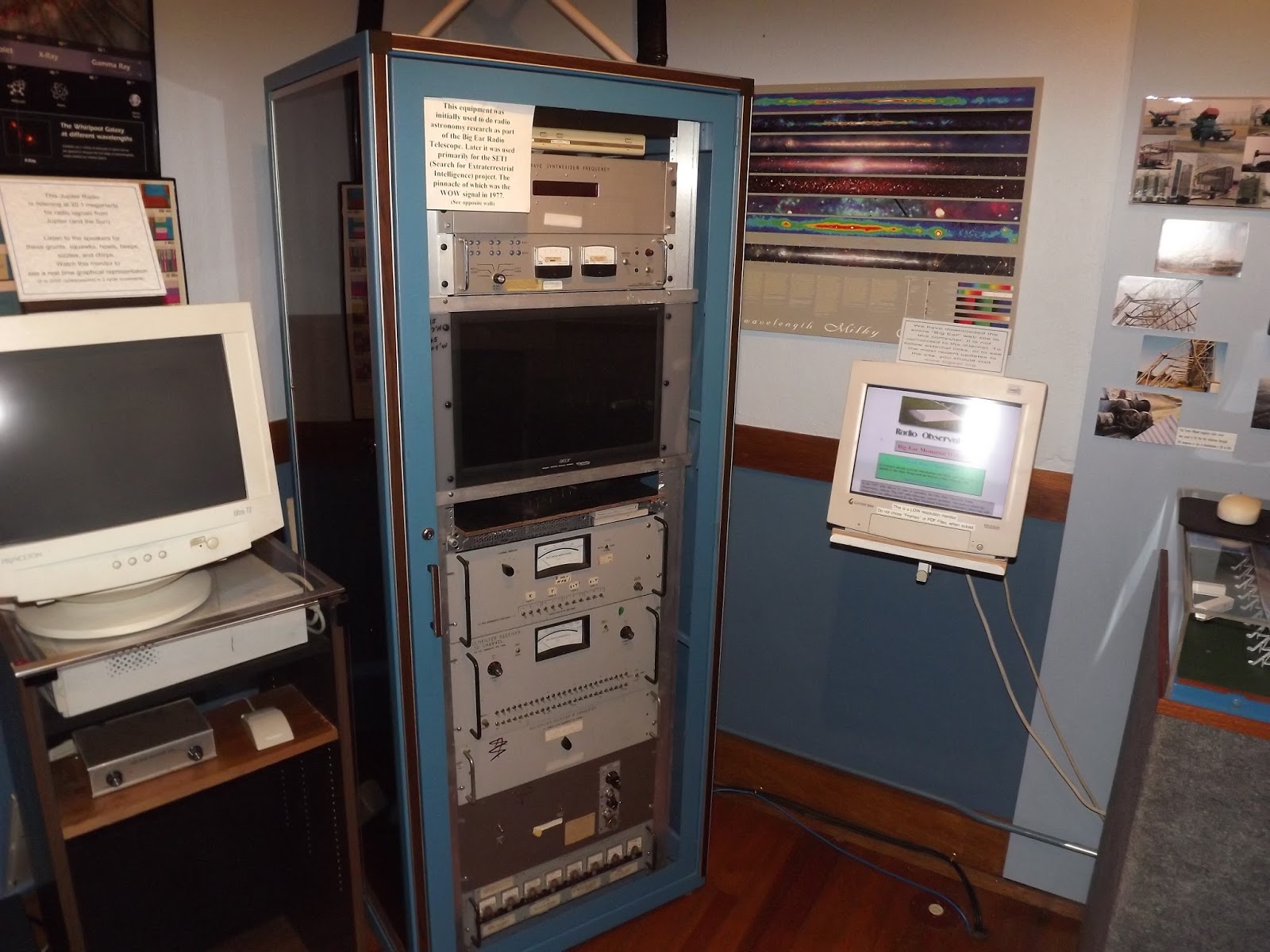
The computer that captured the "Wow!" signal in 1977
on display at Perkins Observatory in Delaware, Ohio
Ehman wrote a follow-up article to the “Wow!” signal in 1997
and again in 2007 where he discussed many details surrounding how the signal
was obtained and what work was done to determine its origin. While Ehman was working with SETI to find evidence of extraterrestrial intelligence
he was not so quick to assume the signal was from an extraterrestrial race.
While many terrestrial explanations were essentially ruled out he still does not
hold a strong opinion on what could have caused the signal. He also warns
against anyone making assumptions about the work by those who do not fully
understand the equipment and software that was used to obtain the data. In his
article Ehman states, “There is simply too little data to draw many
conclusions. In other words, as I stated above, I choose not to ‘draw vast conclusions
from 'half-vast' data’.”
The “Big Ear” observatory was built from 1956 to 1961 and
was first turned on in 1963. The concrete structure was built on the grounds
near the Perkins Observatory that was built starting in 1923 and was not
completed until 1931 when the 69 inch mirror was finally installed for the
telescope. The “Big Ear” was last used in 1997. While the Perkins Observatory
still stands the Ohio State University Radio Observatory was demolished in 1998
due to a variety of circumstances as the land was sold to developers. The area
where this historic signal was detected is now part of a golf course. An Ohio
historical marker stands near the entrance to the golf course on highway 23
known as Columbus Pike just south of downtown Delaware, Ohio.
Pieces of the reflector screen of the "Big Ear" radio telescope
on display at Perkins Observatory
After reading about the new information potentially
writing off the “Wow!” signal I became more interested than ever to visit this
site before the mystery may potentially be erased. I had learned of the “Wow!”
signal early in my study of UFO material and was excited that this took place
in my home state of Ohio. I also knew the facility had been removed, but I had
no idea if anything about the find still existed. On a January 22, 2016, I
visited the Perkins Observatory for a “cloudy night” presentation. Through the
old telescopes and other antiques, the displays of meteor fragments, the
explanations of various astronomical events and heavenly bodies, the outdated
computers, and dusty pictures of rockets and manned vehicles going to space in
a forgotten generation I stumbled upon a room that made my eyes light up. I
walked into a room with a sign above it called “E.T. Radio” which is located
next to the gift shop in the north wing (to the left) just off the center of
the Perkins Observatory. Hidden in the cornerare the only remaining pieces of the “Big Ear” observatory that look like scrap metal. The big thing that immediately attracted me was the original
computer system that took the data for the “Wow!” signal. There is a whole wall
explaining the basics of the signal. There is also a color copy on the wall of
the original printout that contains the signal data which has a short
explanation from Jerry Ehman written in cursive in pen in the margin on December
18, 1999, “After more than 22 years we still do not have a definitive
explanation of this signal. Although we are able to rule out many suggested
explanations, the possibility of this signal coming from an extraterrestrial
intelligent civilization cannot be ruled out.” The original printout is
preserved by the Ohio History Connection (formerly Ohio Historical Society) based
at the Ohio History Center in Columbus, Ohio.
Exterior of the Perkins Observatory on the night of my visit
“If you throw
something up without fact-checking it and you’re the first one to put it up,
and you get millions and millions of views, and later it’s proved false, you
still got those views." - Ryan Grim,
the bureau chief in Washington for The Huffington Post
Credit: lculig/Shutterstock
We’ve all read a story that is shocking, unbelievable, or
just too good to be true. Some people may take the time to actually read the
story before forming an opinion, others may judge on the headline either for or
against the validity of the story based on their beliefs or perspective, and
others may simply share or recirculate the story without reading it with the hopes that someone
else can get to the bottom of it. Then there are those that merely believe
anything and everything they read without thought. I mention this last group
apart from the others since this gullible group is generally the target to
those who intend to fool based on their agenda, beliefs, or just for the thrill
of creating viral confusion or gaining their fifteen minutes of fame through a hoax.
Gullibility does not imply someone is stupid, it merely means some people do
not take or have the time to dig into certain headlines and others may just not
know how to do it. To many these stories really are not worth the time to dig
into and passing it along and looking back later for the solution is much
easier. In some cases I just don’t think people care whether a story is valid
or not anyway, it’s just getting “mind blown” that is the experience; the truth
is boring to some. For others many stories support their beliefs or agenda and
they will pass it off as fact since they have little reason or desire to verify
it. Others may be quick to dismiss stories based on the same beliefs, again
without verification. Technology is the carrier of these memes and it also the
method in which to provide the antidote on a case by case basis. I come from a
time before the World Wide Web of endless information when one had to search
through books to find answers and in the case of the Internet you had to know
what door to look through to find answers without a web browser, Google, or any
way to simply enter a search cue into the system. Even before web browsers and the World Wide Web there were many emails circulated as hoaxes so this is not a new sensation although the large use of social media and the Internet has made this a growing problem. The leading social media platform, Facebook, has attempted to hinder the spread of hoaxes, but to little avail.
There are many ways to look for the truth in a story, but
the easiest way is to spot the misinformation. To spot the things that the
story relies on as fact and expose it as a lie is the best method of
dismantling a story quickly. However, there are some cases in which facts must
merely be looked for elsewhere from more reliable means. An example would be in
the case of a famous person dying, do not rely on fan sites for the information
instead look toward an official channel of a band’s website or their agent for
an official release.
I deal with identifying the validity of stories each and
every day as I gather information for my weekly show, the Paranormal News
Insider. I pride myself on searching for answers instead of merely
regurgitating what appears in print on other sites. While I use many methods to
search for the truth within information I have a fairly reliable method that
has become a habit of use that I use when reading any type of story. This is
what I call my basic “outside in” approach. With this approach I look at the
top and bottom and move my way in to the core of the story to look for details
of a hoax or misinformation. Once key details are established I can begin
searching other resources outside of this page for more details to either
confirm or deny this story, yet this also comes with pitfalls. Some stories
have aspects of these that need to be researched to get a better feel of
whether the story was created or shared by a credible source. Establishing the
source is critical in determining the validity of a story.
With any story a headline can be deceiving. Many of us have
become reliant upon a headline to provide us as much information as possible to
understand a story without actually having to read it. If you have an interest
in a story or intend to share the information it would behoove you to actually
take time to read the entire story for content. There are many clues within the
body of a story that can help you decide whether there is enough credibility in
the story to pass it on. Again, headlines can be deceiving and the content of
the story may have a different version of what you might actually think is
there based on the deception.
Researching general stories found online:
The first step in determining the validity of any story is
to first take the time to read it. A simple way of getting to the truth is to
see if there is already someone who has done research on a story is to merely
search for it. Use the keywords of a story and then enter “hoax” or other words
that you think of that your gut is telling you about the story. Websites like
Snopes.com, Hoax-slayer.com, urbanlegends.about.com, truthorfiction.com, and
many others provide a resource of sanity about many of the hoaxes on the
Internet. Granted, one rule I always
live by; NEVER RELY ON ONE RESOURCE FOR THE TRUTH!
Many people question the reliability of the leader of these
sites; Snopes. This website is edited by a husband and wife team and while
there may be mistakes all of the information gathered for a story is given out
so the research behind every claim is there for the world to see. They have
been judged by a number of other sites to be as accurate as you will find onthe subjects and the accuracy outweighs the minimal mistakes. The same holds true for
another valued, yet many times questioned, resource; Wikipedia. This resource
of information has received a bad rap from many people since it is an
open-source where anyone can edit and update information. However, Wikipedia is
watched closely for updates and requires legitimate resources for major changes
or additions. Many have never questioned the validity of Encyclopedia
Britannica, but Wikipedia has been found to be just as reliable mostly due to
the diligent eyes on its content.
My “outside in” approach to validating online media:
1. Consider the source
Is this a legitimate website? Is
the URL spelled correctly? No? It may be a mirror site (or spoof site) and is created to fool
you into thinking it is a credible source. Is this a parody website?
(onion.com type). Is this from a website
where regular people contribute in blog style? This is by far the most common
type of website hoax where stories are spread via misinformation and will take
the longest to unravel at times since the story is written by the author’s
opinion and web of lies and misinformation. A list of these sites would be in
the hundreds (see a small list below before the resources) and includes sites like beforeitsnews.com, many government,
conspiracy, and UFO sites that are merely fronts for people’s thoughts, ideas,
opinions, fears, and agendas.
2. Consider the resource
The single most important thing
after determining the validity of the website that the story appears on is
finding the original source of the story. Any good media story that is merely
copied and pasted will provide a link to the original source of the story at
the bottom or sometimes the top of their posting. If there is a link open this
one in a new tab and begin to evaluate it to determine the time/date is
actually earlier than the one you originally opened. If this source appears to
be an earlier version this is where you continue your research on the story
beginning with determining if this is a legitimate source as well as if this
story has a resource listed at the top or bottom of the story. The caveat with
this is that there are some sites that back dates stories (such as celebrity
death hoaxes) to confuse people. Continue to chase these sources until you
reach the bottom of the rabbit hole. Unfortunately, many online media outlets
do not take the time to fact check and are merely concerned with website
traffic. Getting you to click on their website puts money in their pockets
based on advertisers, so they honestly care little about the facts up front.
Go local. You can also search for
and look at other sources local to where the story purportedly took place. During
the Jerusalem UFO sightings that seemed extremely credible I was not able to
find any mention of the sightings in any local or regional online sources in
the area and have found the same in many other hoaxes. However, during recent
unexplained noises in Fair Lawn, New Jersey, the best updates were available
from the local newspapers which printed updates which were then copied by the
regional news channel websites. Go to Google and search for the city where the
story takes place and use words like “newspaper” or “news” and you should be
able to find local sources. Granted, searching for phrases of meaning with the
story can help speed up the process by bringing up the multitude of copies of
the story and will allow you to see where they are coming from to aid in the
search for the original source.
If the story does not list a
source for the story then the content must be put into question as well as the
person behind the post. This is a
positive indication that the person may have made this story up or has copied
other information and created a version of a story about something else. Don’t
be afraid to email someone associated with the site to find the source of their
content; their answer or lack thereof will guide you to your answer. In some
cases, such as a UFO, ghost, or cryptid news site the story may have been
submitted to them. The question is then; did they evaluate, research, or
investigate this story or merely put it up on the website as quickly as
possible? Hoaxers and attention seekers will find sites like these to get their
“stories” out in public quickly.
3. Consider the content
Is the story filled with frequent
misspellings, run on sentences, or is the structure of the story all over the
place? Granted, punctuation is not something many in the media worry about
these days as they rely on spell check and many times the comments section will
point out issues which they will silently correct.
Does the content seem to merely support and
idea, opinion, or agenda more than actually reporting an event or story about
something or someone? If so, this website is obviously peddling an agenda and
not a legitimate story. I recommend using key terms in the article to be
highlighted, right clicked, and searched for current information beyond this
story and those that have copied that information until an actual source can be
found if you have not done so already.
4. Consider the evidence
They say a picture is worth a
thousand words and articles can live and die with them. While sadly it has
become common practice for many news agencies to alter photographs in order to
focus on certain things others will immediately fire you for such an act.
Photographs have been edited long before digital methods such as Photoshop came
along and most of us take edited photographs for granted as they appear on
nearly every single magazine on the newsstands.
Many images are altered to provide
visual evidence to support the story. If a story is reliant upon an image you
can take simple steps to search for an original unaltered image if one exists.
There are two methods; Google image search and TinEye that search the Internet
for photographs that have been placed on the web and have been crawled and
recorded on search engines. Both of these resources have plugins that will
allow you to right click on the image and search from the prompt (see resources
below). You will have to scroll through examples of these photographs and see
if you can find other versions of this photograph that indicate that the one in
the story has been tampered with.
There are limitations to mere image
searching. For starters, if the person is using a photograph that has not been
crawled and is not preexisting on the Internet you will obviously not find the
original. Also, if an image is altered significantly it may not show up in
simple image searches. You can combat this by cropping the image or altering
the image eliminating an area you feel is put in digitally using simple methods
such as using paint on Windows-based computers. After retouching you can upload
it to TinEye to see if the alterations helped the search. Another reason for
images not being found is if they are screen captures of videos. On more than
one occasion I have traced an altered photograph to a video. In Google you can
search for topics by category and if I hit a dead end with pictures I may try
to search for relevant videos on the specific topic of the photograph to see if
there is a video with the image.
Be mindful that just because you
are unable to find an altered image does not mean the photograph in the story
is legitimate. There are many other ways to determine the validity of
photographs such as using InfranView and other software to find image
inconsistencies created from digital manipulation to looking at the metadata,
but I’ll save that for a more in-depth look at uncovering the truth.
5. Consider the comments
One highly overlooked method of
finding the truth is based on those commenting on the story. Granted, reading
through comments on stories that rely on belief tend to be full of opinions and
arguments, but occasionally there will be a crusader of research (such as
myself) that will jump in and provide useful information that can dispel these
stories. I usually will peruse the comments section of the viral post as well
as the original source to seek out clues or information that can help me
unravel as hoax.
I will cover YouTube and other videos in a separate blog post in the future.
Sites to question or avoid based on who is able to publish on these sites, their agenda, or other questionable reasons:
Beforeitsnews.com, NaturalNews.com,
InfoWars.com, DailyCurrant.com, NationalReport.net, WorldNewsDailyReport.com, AmericanNews.com, Celebtricity.com, Huzlers.com, DoctorOz.com, TheNewsNerd.com, News-hound.org, NewsWatch33.com, TheRacketReport.com, WeeklyWorldNews.com, Demyx.com, Empirenews.net, MediaFletcher.com, EmpireSports.co, Disclose.tv, FoodBabe.com, Chopra.com, ChristianAnswers.net,
Heartland.org, TheLapine.ca, MediaMass.net, Newslo.com, NewsBuzzDaily.com, EmpireNews.net, TheOnion.com, The
DailyMash.co.uk, Rumormillnews.com, Whatreallyhappened.com, Drudgereport.com, blacklistednews.com,
rense.com, inquisitor.com, examiner.com, even huffingtonpost.com. This is by no
means a complete list!
Resources and further reading:
TinEye: Reverse image search, the ultimate resource for discovering other sources of
pictures by entering URL or uploading directly to system. TinEye has a plug in
that allows for right click usage on multiple browser platforms; chrome,
firefox, IE, safari, and opera.
Google Image Search Chrome Plugin: While you can search and advance search images by going to Google.com you can
use this plugin by right clicking over an image the same way as TinEye.
It was utter chaos in Santiago, Chile on December 22nd, 2015 as a pair of videos demonstrates. The two videos showed up on YouTube and the speculation in the UFO world went wild. The first one, seen at right, created a big buzz throughout the media and UFO and paranormal bloggers alike as everyone weighed in on what they thought was going on.Was this an invasion of several alien craft? No. The simple fact is this event happens every year. Similar videos have also popped up ever since 2003. The reason for this yearly occurrence is these lights in the sky are actually T-35 pillar propeller driven aircraft used by the Chilean Air Force. What we are seeing is the end of the graduation ceremony where the two-seater craft are flown over the skies of Santiago.