Showing posts with label science. Show all posts

Monday, July 17, 2017

New Book Release- "Handbook for the Amateur UFO Investigator"

Brian D. Parsons, PhD, celebrates his sixth book release with his take on how to research and investigate UFOs. This book brings his "Handbook" collection of anomalous research guidebooks full circle with a closer look at this controversial and conspiracy laden topic.

His latest effort is a balanced look at the UFO phenomenon through the culture and history of sightings and related phenomenon. Brian looks at a number of historical UFO sightings and brings you the truth behind these events that have shaped our thoughts on the reality of alien crafts visiting Earth. From there he identifies other phenomenon typically related to UFOs and puts them into perspective. Following this is an explanation into how UFOs have been shaped by culture with books, radio, television, and movies.

The book then describes a number of logical solutions to UFOs before landing into methods of research and investigation. From here the reader will learn thorough methods of interviewing clients based on science as well as his own methods crafted from over 20 years of anomalous research. Onsite investigation methods as well as offsite research techniques are also discussed and the book is then topped off with a list of resources that will help point anyone of any background of investigation in the right direction of becoming a well rounded UFO investigator.

Brian is the author of Handbook for the Amateur Ghost Hunter or Paranormal Investigator: How to Become a Successful Paranormal Group in 2008, Betty's Ghost: A Guide to Paranormal Investigation also in 2008, Handbook for the Amateur Paranormal Investigator: Part II: The Art and Science of Paranormal Investigation in 2011, The "E4" Method: Breaking the Mold of Paranormal Investigation in 2013, and Handbook for the Amateur Cryptozoologist in 2014 with a second edition in 2015 which includes a foreword by Loren Coleman.

Wednesday, August 10, 2016

Ten questions every ghost investigator should ponder


  1. Why am I doing this? Or, why do I want to do this? No, not the generic “solving the mysteries of mankind” answer, but why do you personally spend your time, effort, and money pursuing this? Is it a personal quest for answers? Search for spiritualism? You may not have a definitive answer or you might just be doing it for the thrill, but the further down this list you truly go the truth may rise to the top.
  2. What do I want to get out of this? This question rides on the back of the why question. Once you know why you are doing it you may realize it is a personal pursuit or desire for subjective stimulation or even a quick way to fame. If this is the case you should stay away from client-based cases. If your answer to question 1 is to prove ghosts exist with cameras and EVP you'll need to do more than merely be a ghost hunter as subjective hunts will only create more questions than actually providing answers. Many do this from the allure of those on television, but ask yourself if an ego-driven motive is worth all of the hassle for just 15 minutes of fame.
  3. What am I willing to invest? A follow up would be, “And is it worth it?” A financial stake is more than some people can do let alone giving up weekends and many evenings pursuing this. The costs of a serious team can weigh down on anyone and the more you go down that path the more of an investment of time and money it will become.
    The bad side of this is that for many the investment in tools means an investment in evidence. In other words, if they spend a lot of money on gear they will ultimately get "evidence" no matter what the cost. You will also have to learn many new skills if you wish to become proficient at seeking the unknown. -These first three are just to get to gauge the basics, but the next one digs into the heart of your beliefs.
  4. What are my beliefs about the paranormal? This is an important one. This one question will define what type of an investigator you are as well as how you approach cases as well as whom you surround yourself with. This includes, but is not limited to; belief in ghosts, demons/angels, camera orbs, use of various equipment, full moons creating better ghost atmosphere, solar storms creating better ghost atmosphere, investigating in the dark, investigating during "dead time", lockdowns being a good method of investigating, what ghosts are defined as (parapsychology definitions versus spiritual), and so on.
  5. Am I willing to challenge my own beliefs about the paranormal?
    Are you willing to review the work that challenges your beliefs with an open mind? If you are not willing to even think about challenging your beliefs than you’re not really an investigator you’re merely a believer that is looking to support your views through subjective experiences as well as taking evidence and skewing it to fit your beliefs. I've met far too many people who are merely in this to find things that they can quickly state are ghosts merely to support how they feel. This is not objective or scientific and is merely a form of thrill-seeking. This is fine if you merely want to go to haunted prisons/hospitals, etc., but don't claim to be "scientific" and certainly don't act like you're doing anything constructive.
  6. Am I willing to continue to learn? Certification courses cause anger with some individuals, but where else can one become educated in this field? Books offer a good start, but eventually everyone needs to ask others who have come before them in order to make true sense of things. It's one thing to regurgitate facts, but it's completely different to put theories to work. This is why many teams merely walk around in the dark asking silly questions. Many certification courses are garbage since those that created them are merely passing on beliefs and opinions or only know book definitions and have never applied much of it in the field. However, there are some courses that provide some great information and education (IMHS and TFU). Are you willing to look to others to continue to make yourself a better researcher and investigator? (Interviewing skills, electronics, critical thinking, science, parapsychology, etc.)
  7. What are my goals with doing this? This question creates a focus of the first and second question now that you have pondering the above questions. This goes beyond getting a television show or writing a book and is an evolved look at what you want out of the field and what you are willing to do in your life to make it happen. Think of how you would want to be remembered as a person after you are gone. Imagine, as grim as it sounds, standing at your own funeral –
    how do you want to be remembered? What will your friends say, how will those who knew you in the paranormal field remember you? This question takes a deep look at your character and if all you want to do is visit haunted locations and meet celebrities that's fine, but don't assume this sets you apart from everyone else - people see this and are judging you on your actions!  
  8. What path will I take to get to these goals? This heavily relies on pondering the above questions. If you are not willing to evolve with your beliefs as well as your knowledge your path will be a short one, guaranteed. This is true with any type of goals in life and shortcuts and laziness will lead you nowhere. Wishing and hoping just don't cut it and while timing and luck may come into play nothing is better than working hard, making sacrifices, and pushing yourself to new limits.
  9. What have I learned so far? Occasionally stepping back and looking at where you came from can help give your perspective on what you have learned and experienced along the way. This can aid you in identifying weaknesses or potential flaws in your methods or beliefs and may serve to help guide you on a better path. Taking stock every once in a while can help you reorganize your direction and help you obtain new goals and set new personal expectations for accomplishments such as writing books, being a vendor at a paranormal convention or even getting up and speaking at one.
  10. What can I do better / and how do I get there? Creating a personal business plan around goals or self-improvement needs is a good way to motivate as well as compartmentalize obtaining goals. If you break things into small chunks within a timetable and provide a pathway to getting to each goal you will be able to become better in all aspects of life. Once you have reviewed and pondered the first 9 questions the tenth will be much easier than thinking about it right now.

            These questions will also work with cryptid and UFO investigators as well and you may even be able to use these questions for any other aspect of your life.

            Monday, January 25, 2016

            “Wow!” Signal: A new potential explanation and my journey through history before the mystery is (possibly) lifted

            Photo BigEar.org
            On August 15, 1977 at 11:16 PM eastern daylight savings time the Ohio State University Radio Observatory (OSURO), or affectionately called the “Big Ear” radio telescope in Delaware, Ohio, recorded what is now known as the “Wow!” signal. At the time the signal came in no one was at the facility. A few days later (possibly August 19th) Jerry R. Ehman was reviewing printouts that were delivered to him at his home from Gene Mikesell, a technician who was in charge of taking care of the IBM computer that was doing all the work at the site. Every 3 to 4 days Gene would stop, reset, and then restart the computer due to its limited amount of room for data and then bring the stack of printouts to Ehman to look through. The men were part of a volunteer effort to detect narrow band signals that could possibly be sent from an extraterrestrial source known as the SETI project, short for the Search for Extraterrestrial Intelligence, which uses various satellites to search for signals in space. Ehman and others involved in the project had formerly worked at the radio telescope until the National Science Foundation suddenly shut off funding in August of 1972. In December of 1973 until 1995 the radio telescope was used for the volunteer effort of the SETI project after it had completed a radio survey of the Andromeda Galaxy in 1963 and the Ohio Sky Survey between 1965 and 1971.

            Color copy of the signal with a note from Jerry Ehman on December 18, 1999
            on display at Perkins Observatory in Delaware, Ohio. (click to enlarge)
            As Jerry sat and reviewed the printouts he suddenly saw the data from a few days prior. In a vertical column with the alphanumerical sequence “6EQUJ5”, that represents 72 seconds worth of information gathered from the radio telescope, he circled the data and wrote “Wow!” in the margin. The alphanumeric code essentially describes the intensity variation of the signal and it has been given two different values for its frequency within the 1420 Megahertz range which puts it in the hydrogen line frequency. What does this mean for searching for extraterrestrials? SETI believed that since hydrogen is the most common element in the universe extraterrestrials might use that frequency to transmit a strong signal. The problem is researchers have been unable to find the signal from the original source of the constellation Sagittarius, near the Chi Sagittarii star group.

            John Kraus, Bob Dixon, Ehman, and others poured over the data and attempted to find a cause. All terrestrial causes were ruled out, in the words of Ehman ruled out means “to assign a very low probability to.” The researchers also considered other celestial explanations, but nothing could satisfactorily explain the data. Unfortunately, the data was limited due to the technology and software used, and since it was never repeated does not offer any additional help to ever be solved.

            In 2016 a new hypothesis was presented after nearly 40 years of a lack of a definitive answer. Antonio Paris, a professor of astronomy at St Petersburg College in Florida, and Evan Davies proposed that the signal actually originated from one of two comets that were flying by at the time. Many researchers feel that since the signal has not been observed again from the same origin that it must have been something passing through the area between the observation point and the intended target of the Sagittarius constellation. James Bauer of the Jet Propulsion Laboratory in Pasadena, California, is skeptical of this hypothesis since the comet would have to release a significant amount of hydrogen to produce such a signal. Paris states that in order to rule out the comets his hypothesis needs to be tested. Comet 266P/Christensen will be back in that region on January 25, 2017, and P/2008 Y2 (Gibbs) on January 7, 2018. By studying their radio emission and how quickly they move in the sky, astronomers should be able to tell if it really was this that produced the “Wow!” signal.

            Some may think that Antonio Paris is just here to ruin the longstanding belief that this is a piece of leading evidence in the support of life outside of the Earth. Paris is the founder and director of the Aerial Phenomena Investigation team that is a worldwide effort to actively research and investigate UFO claims. His goal is not to discredit Ehman, but to hopefully provide answers that have plagued this code for so long.
            The computer that captured the "Wow!" signal in 1977
            on display at Perkins Observatory in Delaware, Ohio

            Ehman wrote a follow-up article to the “Wow!” signal in 1997 and again in 2007 where he discussed many details surrounding how the signal was obtained and what work was done to determine its origin. While Ehman was working with SETI to find evidence of extraterrestrial intelligence he was not so quick to assume the signal was from an extraterrestrial race. While many terrestrial explanations were essentially ruled out he still does not hold a strong opinion on what could have caused the signal. He also warns against anyone making assumptions about the work by those who do not fully understand the equipment and software that was used to obtain the data. In his article Ehman states, “There is simply too little data to draw many conclusions. In other words, as I stated above, I choose not to ‘draw vast conclusions from 'half-vast' data’.”

            The “Big Ear” observatory was built from 1956 to 1961 and was first turned on in 1963. The concrete structure was built on the grounds near the Perkins Observatory that was built starting in 1923 and was not completed until 1931 when the 69 inch mirror was finally installed for the telescope. The “Big Ear” was last used in 1997. While the Perkins Observatory still stands the Ohio State University Radio Observatory was demolished in 1998 due to a variety of circumstances as the land was sold to developers. The area where this historic signal was detected is now part of a golf course. An Ohio historical marker stands near the entrance to the golf course on highway 23 known as Columbus Pike just south of downtown Delaware, Ohio.

            Pieces of the reflector screen of the "Big Ear" radio telescope
            on display at Perkins Observatory
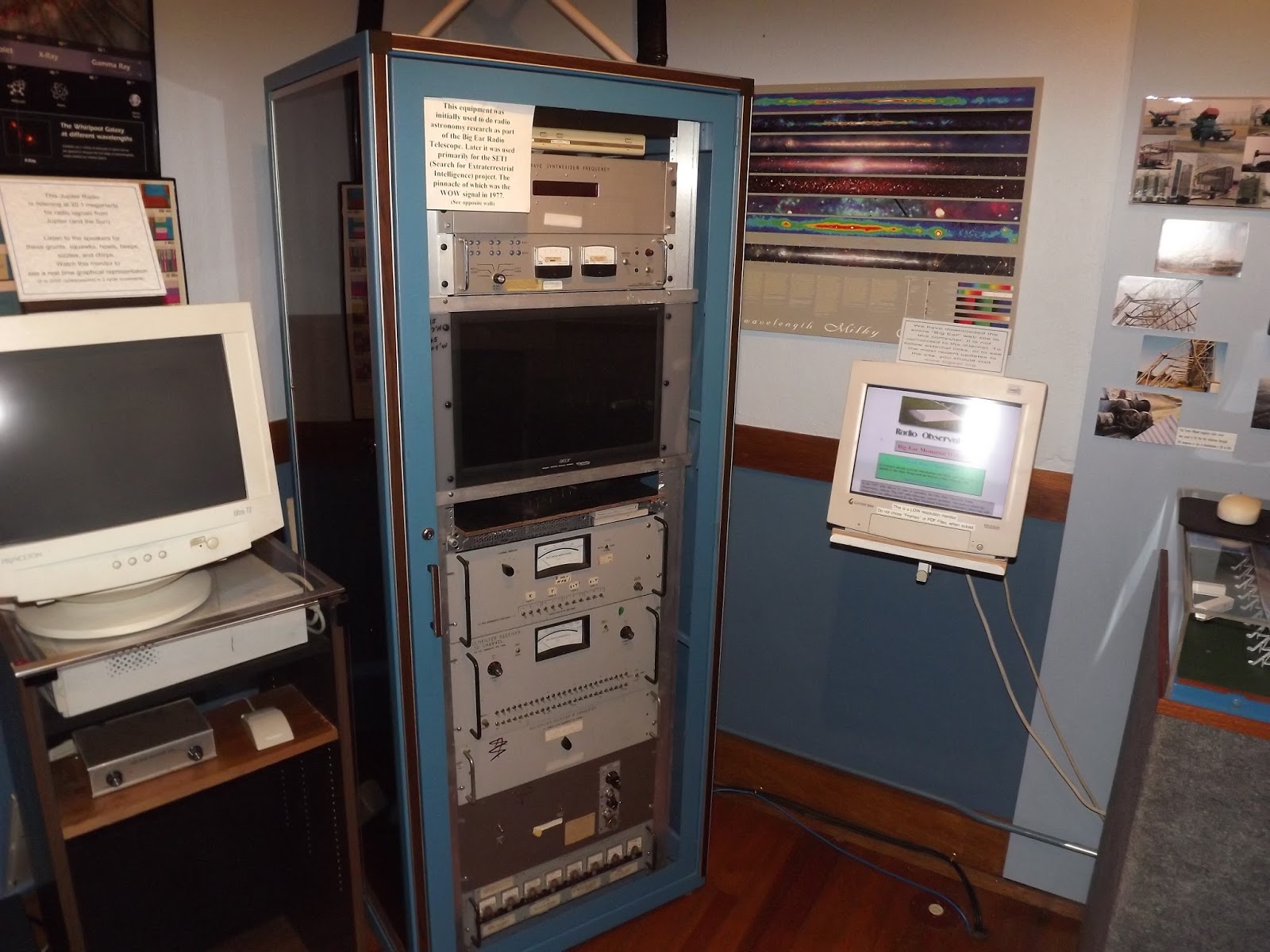
            After reading about the new information potentially writing off the “Wow!” signal I became more interested than ever to visit this site before the mystery may potentially be erased. I had learned of the “Wow!” signal early in my study of UFO material and was excited that this took place in my home state of Ohio. I also knew the facility had been removed, but I had no idea if anything about the find still existed. On a January 22, 2016, I visited the Perkins Observatory for a “cloudy night” presentation. Through the old telescopes and other antiques, the displays of meteor fragments, the explanations of various astronomical events and heavenly bodies, the outdated computers, and dusty pictures of rockets and manned vehicles going to space in a forgotten generation I stumbled upon a room that made my eyes light up. I walked into a room with a sign above it called “E.T. Radio” which is located next to the gift shop in the north wing (to the left) just off the center of the Perkins Observatory. Hidden in the corner are the only remaining pieces of the “Big Ear” observatory that look like scrap metal. The big thing that immediately attracted me was the original computer system that took the data for the “Wow!” signal. There is a whole wall explaining the basics of the signal. There is also a color copy on the wall of the original printout that contains the signal data which has a short explanation from Jerry Ehman written in cursive in pen in the margin on December 18, 1999, “After more than 22 years we still do not have a definitive explanation of this signal. Although we are able to rule out many suggested explanations, the possibility of this signal coming from an extraterrestrial intelligent civilization cannot be ruled out.” The original printout is preserved by the Ohio History Connection (formerly Ohio Historical Society) based at the Ohio History Center in Columbus, Ohio.
            Exterior of the Perkins Observatory on the night of my visit
            Resources:

            Tuesday, March 31, 2015

            Second Edition for "Handbook for the Amateur Cryptozoologist"

            My fifth book, "Handbook for the Amateur Cryptozoologist", was published in February of 2014. Since then, the book has been recognized in the July/August 2014 edition of "Skeptical Inquirer Magazine" in the New and Notable Section as a positive book review. At the end of the year it was again recognized as one of the The Best Cryptozoology Books of 2014 by renown cryptozoologist Loren Coleman. He labeled the book as "The Best Guidebook for The Cryptozoologist-In-Training of 2014." It was a huge honor to be recognized by a living legend of the field of cryptozoology for my work. It was also a huge honor to be reviewed by a skeptical organization and given a virtual "thumbs up" for a book that offered a balanced view on a controversial subject.

            After Loren Coleman contacted me for a review copy, a few weeks later he let me in on the fact that the book would make his year end list. Loren also wanted to sell this book at his International Cryptozoology Museum that is located in Portland, Maine. He was also curious to know if I was interested in including a preface to the book supplied by him. Earlier in the year I had made some revisions to the book in order for it to be included in an online school (name withheld due to not being completed at this time) and knew of a few other changes I wanted to make. I had never considered having someone write a preface, or rather a foreword by definition, for one of my books, but if I was for this book it would be no one other than Loren. So, in March of 2015 I re-released the book as a second edition. It is still only available at my personal online bookstore at Lulu Press and will be available at Amazon and other online retailers soon as the first edition is still available.

            Interestingly, this book was a lot of work but I really did it for fun as it was a "diversion" of sorts away from my ghost handbooks and my work on the "E4" Method that included several on-site client investigations and months of research prior to that. This book was a lot of fun to write and I felt like it connected to me more of a person as I used my past to talk about concepts of the book. My other books were successful in their own right and I enjoyed my "tour" with the "E4" Method book that included conferences in Maryland, Virginia, and several appearances in Ohio and Pennsylvania not to mention numerous podcast interviews which was still a lot of work. Offers to review the "Handbook for the Amateur Cryptozoologist" seemed to come to me with little effort (there are more to come) and I had never thought of this book as one that would generate as much interest as it has so far. Every project I work on I attempt to expand my knowledge or experience with something, and while this book is still "self published" I am still proud of what it provides and I feel this is my best writing and overall book to date.
            The “Handbook for the Amateur Cryptozoologist” explores the history and mystery behind some of the most elusive creatures found - and some that are still hidden. The handbook provides a well-balanced look at many concepts necessary to conduct proper client-based investigations. Cryptozoology has been shadowed under the umbrella of pseudoscience due to a myriad of problems. This book takes a skeptical, yet balanced, stance to help the newcomer or seasoned veteran gain solid footing into using a more scientific approach to the field. It will also arm you with the basic abilities necessary to become a successful researcher and field investigator in the field of cryptozoology. It explores the use of technology in the field as well as the methodologies behind investigations and expeditions that go beyond the television style of thrill-seeking. This handbook will be your basic guide to becoming a responsible and rational investigator in a field wrought with hoaxes and misinterpretations.
            This book is available now at my personal bookstore at Lulu Press.

            Wednesday, December 23, 2009

            The Science of Ghost Hunting and Paranormal Investigation Part III: Physics 101

            My original intent for part III for this series on science in the ghost field was to focus on the scientific process and how the tools we use play their part. In part I, I discussed the basics of the scientific process and how that affects the field we work in. Part II centered on the advancement of tools and technology in our field and how this is a double-edged sword.

            I decided to derail the subject once again due to a friendly debate I have been having with a colleague over the usage of the First Law of Thermodynamics. You’ve seen this quote a hundred times if you’ve visited paranormal websites or message boards:

            “Energy cannot be created nor destroyed, only shifted from one type to another.”

            To many this is the proof they need to show others that ghosts indeed exist. Science states that since energy cannot be destroyed when we die the energy has to go somewhere and that somewhere is more than likely as a ghost!!! Yikes. I’ve grown tired of seeing this thought process and the mantra that is passed from group to group without any critical thought as to its real implications. If we follow this thought process a car should continue to run forever without ever needing fuel. Sound silly?

            Let’s take a closer look at this First Law of Thermodynamics, which is also known as the “conservation of energy”. The “types” of energy that are referred to within the description of the conservation of energy are more or less potential and kinetic energy. Potential energy could be described as gravitational potential as a car climbs a hill. As it climbs the hill it is actually storing energy (gasoline and engine aside), as it reaches the top and begins to descend the stored up energy is now used. It cannot use more energy than what was stored and will use up all of the potential energy even if it begins to climb another hill (of course, it begins to store more potential). The kinetic energy comes into play as the energy that was stored is now converted into useful energy that propels the car down the other side of the hill without the need of the engine to help.

            (Pictured at left is William Thomson, A.K.A. Lord Kelvin, who was responsible for most of the intricate work of the laws of thermodynamics)

            There are obviously other types of energy (heat, friction, sound, vibration, light, etc.) that this energy is transferred to, but this energy is lost to the environment. Lost? How can it be lost, it can’t be created nor destroyed, right? Exactly, the energy is transferred to something that cannot flow back into kinetic or potential energy, the energy is used but not created or destroyed. Again, with the example of the car, some of the energy is lost due to the friction of the wind and the tires. This energy is being used, but not to push the car forward, instead it is taking away the kinetic energy provided by the engine. So, what the heck does all of this have to do with ghosts? Let’s move on to part two for the answer (and we won’t even get into how this governs heat, which is why it is called thermodynamics). Yes, there are two parts to the Law of Thermodynamics.

            The first law states that energy is conserved; the second law would then state that energy always goes from more useful to less useful forms. A car uses gasoline to power the engine. The power created by the engine is not entirely used to push or pull the car forward. There is wind resistance, tire wear and resistance, gravity, dirty oil, and dozens of other things that take away from the engine from being completely efficient. The fuel that is used cannot be used completely, some of the fuel turns to carbon dioxide(and other gasses) and is released into the environment, the burning of the fuel causes heat which is lost energy or energy that is converted into a less useful form.


            Within the second law there are also three statements, the first being; “Heat energy always flows spontaneously from hot to cold”. Let’s start talking about ghosts now. If we follow the laws of thermodynamics we should get a spike in heat prior to having a measureable cold spot. It goes against physics to have a spontaneous cold spot appear without there first being heat present (or a measurable form of energy, and no, the EMF detector is not picking up a ghost in transition much to the dismay of many of you reading this). For many ghost groups the third statement of the second law applies, “The amount of disorder in any isolated system cannot decrease with time”. Yeah, I’ve got jokes.

            Let’s go back to the second law. Energy goes from useful forms to less useful forms. When the body dies our heart stops. The heart supplies blood and oxygen to our vital areas of our body and also takes away the toxic carbon dioxide out of the blood stream. The heart also gives us our electronic signature as blood creates friction through our body which is composed mostly of water and salt. When our body dies it begins to decompose almost immediately. There are millions of bacteria that live on our skin, in our hair and other places that are part of a symbiotic process that begins to go in their favor when the body dies. To spare you the gross details our bodies are basically reduced to dead tissue and cells. Any electrical signal we have goes out immediately when the heart no longer functions. The brain creates electrical impulses as well, but is completely dependent upon blood for its survival. There is nothing measureable that escapes the body when it becomes nonfunctioning. Yes, for some of you who have done your homework there were experiments done on dying patients where there was an observed decrease in weight as the person died. These experiments were done in less than ideal conditions and the results were not as conclusive as they are stated.

            These laws are basic and are deceptively simple in their statements. No laws of science describe ghosts and this is why ghosts are considered paranormal. In order for ghosts to be explained many different laws will need to be amended or rewritten (from thermodynamics to Maxwell’s equations). Even if or when we are able to unlock some of these answers we’ll still have to deal with the Heisenberg Uncertainty Principle (google it for some more mind-opening adventure).

            So what’s being done about all of this? There is the occasional shift in thought in our field to various theories within physics (enlightened armchair theorem) that help to explain what might be with ghosts, but does not offer any practical method or explanation about any aspect. When I first came into the field the Chaos Theory was in full bloom, many people know this as the “butterfly effect”, a butterfly flaps it wings in Central Park and this action eventually makes it rain in China. This theory gave birth to the idea that it was just a matter of time until the mysteries of ghosts were unraveled, yet, here we stand at the same point we were then. New theories have presented themselves over the years; a popular one now is the string theory (or really called super symmetric string theory – although there is more than one version). Many are jumping on board with this since there is the inclusion of interdimensional properties (which is also included in other theories). The string theory is nothing more than a mathematical formula designed to answer large scale problems with the four forces of nature on an atomic scale, there is no evidence whatsoever that any of it is accurate which is why it is just a theory. Granted, a couple of other guys named Newton and Einstein had their own theories years ago as well and those turned into laws of nature.

            Paranormal investigators should keep a close eye on the advancement of particle physics. The Large Hadron Collider on the border of France and Switzerland has made the headlines in the last few months and will more than likely see more headlines in the near future. It’s been said that the power of this underground collider is so great that it might cause microscopic black holes that could “swallow” the Earth or even create antimatter that would devastate the entire universe (theoretically possible, but highly unlikely). This tool will be used to uncover more secrets about our atomic world, but will also help us understand the possibility of other dimensions and other potential aspects that can bring us closer to real answers about what we see as paranormal. The other half of our concentration should be on the medical world. The brain, or better yet, the mind, is part of the equation when dealing with ghosts. Ghosts are about interaction and it’s more than likely a symbiotic relationship between us that allows for them to be a part of our perception.

            Saturday, August 29, 2009

            The Science of Ghost Hunting and Paranormal Investigation Part II: Advancement of Technology

            "Technology has advanced so quickly that it's just a matter of time until the truth of ghosts are unveiled."

            Not my words folks and that's why they're in quotes. I agree that technology has advanced in the field of paranormal investigation even since I have been a part of it, but does that mean we are really closer to finding answers? Some seem to think so, but personally I think it actually has set us back a bit.

            In my last blog in this series, "The Science of Ghost Hunting and Paranormal Investigation Part I: The Basics of the Scientfic Approach", I discussed the scientific process and how it ties in to our field. While technology plays a part it's not the headliner that many make it out to be, it's merely the supporting cast to a symphony of processes, procedures, and documentation. The technology can certainly add to the data collected as well as make up for our interpretation of events, but it can still get in the way or make our data give us the results we are looking for. I don't want to beat a dead horse in this blog, rather I am going to discuss the advancements in technology that could potentially lead us to the opening quote.

            You might be surprised to learn that pagers are still in use by many emergency personnel as well as Information Technology (IT) professionals. Don't remember pagers? Well, my first "Emergency Contact" number used for my paranormal group was for my pager. I was the last in my family to get a cell phone and I am now on my fifth phone in I don't know how many years. Even when cell phones were becoming mainstream we never dreamed they would be taking several minutes of video, connecting to the internet with ease, providing GPS data, PowerPoint presentations or all of the other things that come standard on many phones today.

            The biggest advancement over the years with cell phones has been the camera phone. This of course, follows on the heels of the advancement of digital cameras which are taken for granted in this day and age. When I first began in this field I had to buy film for my 35MM camera as well as pay to have it developed. A typical roll of film held 27 exposures (I use to take as many as 30). If you knew how to handle the photo business you only had to pay for what you wanted, and you were sure to tell the technician to develop all of the pictures regardless of their appearance. Of course there was also the Polaroid camera that took instant photos that was the rage for quite a while in the paranormal field and it saved you a trip to the photomat.

            What a hassle, that's all I have to say about film cameras. It wasn't so much the cost, it was all of the hassle about buying the film, keeping it out of the sun, away from static, loading it in darkness, taking it to get processed and sometimes having to go back to pick it up. While it did cost a lot to buy and process film, digital cameras balance out that cost, but have less of the hassle. Although, when digital cameras made their splash with the paranormal field so did a little problem now known as "orbs". This phenomenon is not new nor was it coined by some "Dr." who cruises around on subscriber's money in a Winnebago. Orbs have been around since the film camera days as mentioned in many magazines and books about photography printed in the 1960s and 70s that I have read (I was a big camera fan as a kid).

            The field I call "Orbology" came into study when digital cameras made their way into our field. The big problem in the early days was pixelization. Basically, the camera was adding pixels to the picture due to the limitations of the technology at the time. So what's the cause now? One word: Flash. The camera technology has gotten better and with better comes compact. When the cameras got better they started getting smaller and when they got smaller the flash moved to over top of the lens. The flash can reflect off of close proximity dust or airborne debris right into the lens thus creating orbs. We see the orb as being in the picture, hey; the cat is looking at it! In reality its 0-4 inches from the lens of the camera and thus won't be seen by the naked eye.

            Another double-edged sword that came with digital cameras was the technology to alter the images taken by them. When a picture was taken with 35MM there were only so many ways the photo could be faked and if the negative was provided as evidence it would narrow down the possibilities to chemicals and static electricity. Digital manipulation has rendered photography and video nearly useless for paranormal investigation as well as use in other anomalous fields (UFO and Cryptozoology) since even children can create photos and videos that can take even a little work to uncover manipulation. How can you prove a photo has not been tampered with? Well, EXIF information in photographs is a start, but how can you do the same with video?

            Along with cameras, the other recording media that has advanced from magnetic recording to digital is audio recorders. My first recorder I used in paranormal investigation used a regular sized tape cassette and was "portable", meaning you could clip it to your belt or carry it around as it certainly would not fit in your pocket. The big "rule" about using cassette tapes was to use fresh ones and only record on one side to prevent bleed-through. Well, I used both sides and would use the same tapes over, but only on recording the interview. I used to buy TDK D90 tapes in a ten pack about once a week back then (can't remember how much they cost, more than likely about $15). Even with an external microphone you would still get a lot of hiss and the occasional squeaky wheel (I learned how to lubricate the parts and even pad certain parts to keep the "machine" noise to a minimum). I eventually bought a micro-cassette recorder which I still use to this day, still expensive to buy tapes and a real blast to review.

            Now we can walk into a department store and buy a digital recorder with a USB plug and can upload our files with ease to the computer. Prices on the digital recorders have fallen sharply and the expensive models carry a huge amount of space. Again, the big problem with technology is the ability to create fake results or to over analyze files to come up with results you desire. Technology works against us
            once again.

            Now that the camera and recorder bubbles have been burst, we look at the other technology that we use in investigations. What about EMF detectors? My first detector was a Trifield Meter that I paid $250 for. It was worth every penny when I met someone in the field that would "oooh" and "ahhhh" over it, but it met its demise with an unhealthy trip down a flight of stairs at an abandoned TB hospital. I didn't drop it, but I can't swear it was helped by paranormal forces. Anyway, a quick search on the internet and I can find a new one for $130. We know that EMF detectors are not ghost detectors (despite some of the names given to some of them) and are not designed for our field. That is until Pro Measure introduced the MEL-8704, designed for paranormal investigators by paranormal investigators, hit the market. It has not taken long for this meter to begin to morph from suggestions given by its users; this is good advancement for our field as long as it is used correctly!

            (The new Mel 8704 Hybrid with KII built right in)

            Better technology and dropping prices have put many new meters in the hands of those who have little idea what the measurements mean or how the meter is affected, but it's not the technology's fault. The once $20,000 thermal imaging cameras are now only a couple grand each and getting cheaper every few months. Handheld weather devices are now inexpensive to carry. I use my cell phone to gather local data periodically to update our investigation forms, but having the data that is occurring in the room is essential to tie this data to the investigation. New technology is being developed for other purposes and beginning to become affordable.

            The thing to keep in mind, again, is to remember the limitations of these instruments and use them as references, not answers. The key to using these scientific tools is to use them scientifically. Meaning, documentation of everything you do is essential if you are going to post your data and posting this data is the last big step in your work.

            In order for these tools to assist us in moving forward we have to move forward as gatherers of information. Groups need to learn how to gather the data to support the use of these tools correctly. Random videos of orbs and shadows will never provide any proof beyond personal proof. In order for documentation to have weight it needs data and data needs documentation. No one likes filling out paperwork, but if we are to move forward as a field of science, we need to act like a science first.

            Coming soon: Part III in this series of the Science of Ghost Hunting and Paranormal Investigation will offer a closer look into where I left off in part I with the scientific method and how the tools play their part.

            Saturday, July 25, 2009

            The Science of Ghost Hunting and Paranormal Investigation Part I: The Basics of the Scientific Approach

            The word “science” or “scientific” has been thrown around in the field of ghost hunting and paranormal investigation for many years. What does science offer a field that is almost completely philosophic in nature, from the lack of insurmountable evidence to the loose theories that fuel our pursuits?


            In my last blog I discussed the beginnings of the Spiritualist movement which was the catalyst behind Parapsychology and the scientific pursuit into ghosts and related phenomena. Psychical Research, now Parapsychology, helped separate the fakes and frauds of mediums, table tipping sessions and man-made spirit photography. Through all of this there have always been amateurs who have worked in the background of the professional organizations and individuals, at no other point since the beginning of the Spiritualism era has the amateur ranks played such an important part of ghost and paranormal research. The Society for Psychical Research (SPR, 1882) and the American Society for Psychical Research (ASPR, 1885) still exist as well as other professional arms of paranormal research (Parapsychological Association, Rhine Research Center, Institute of Noetic Science, etc.) though the amateur ranks outnumber the professional ranks as well as the overall exposure and interaction with spontaneous cases.


            What separates professionals and amateurs, besides a degree from a University and and/or a professional organization is the interpretation and use of science. The raw form of scientific approach in the historical context of parapsychological study was mere case reports (data collection). This would merely be a collection of firsthand accounts of paranormal activity as well as possible witnesses. This was not enough to make this into a science until they were able to systematically study or replicate experiments with these reports.


            This now draws us to the 21st Century and the amateur pursuit of this field using scientific tools. The use of tools in this field (EMF detector, compass, dowsing rods, ion detector, infra-red thermal imager, camera, camcorder, cassette and digital audio recorder, motion sensors, etc.) has seemingly clouded the minds of those who are attempting to verify anomalous phenomena through them. Many people think that the mere use of these tools is science and having anomalous readings with them serves as evidence of the paranormal.


            There is no such thing as a ghost detector. No tool in use in the field of ghost research has the ability to determine a ghost is present. The mere use of these tools alone does not constitute a scientific endeavor. These preceding statements are not my opinions, these are fact. These statements have been made by parapsychologists and others in various scientific disciplines.


            It seems that the objectivity of the use of these tools has been overlooked since many groups have stated they have collected data that they have detected the presence of ghosts. But the question is, how do they know it has detected a ghost and not another anomalous object or field of energy? If the detection with the instrument was accomplished in addition to an anomalous event happening at the same time then we have a possible legitimate reading on our hands (see Auerbach, (2004, p. 112). Then we have to ask if there were baseline readings done of this area in question prior to and after the anomalous reading (without altering the environment, i.e., turning off lights or power)? Were there witnesses to this event or any other devices that could back up the other? We could wonder whether those who set out to gather this evidence may have unintentionally created the anomalous event. Is this a repeatable event? To many ghost hunters this sounds like an impossible task, but it should to most since this is how real science works. Believe me, I am being generous in my examples here compared to those that would be required for other scientists to have a sliver of belief in what we are trying to accomplish.


            The major piece of the puzzle that would come next would be for the group that encountered these readings to go through a formal scientific process and ultimately publishing their findings and have another group attempt to gather the same data (or finding discrepancies with the prior data collection methods) using similar or related instruments. I can already hear some people out there laughing at the premise of a group inviting another one out to confirm or deny their findings, though in fairness I know quite a few that would be happy to do this. The bottom line is that this is true science. Merely wielding tools of science is not scientific, even if you know how to use them, which is my whole point here.

            Let me share with you an excerpt from the handbook I designed for the Ohio Paranormal Investigation Network in dealing with the scientific approach as well as steps in a scientific investigation.

            The Scientific Approach to Behavior

            There are three sets of interrelated goals to turning a hypothesis into scientifically accepted data; measurement and description, understanding and prediction, and application and control.

            Measurement and Description- Before a scientist can explain why the world works in a certain way; they need to describe how it works. Science’s commitment to observation usually requires that an investigator figure out a way to measure the phenomenon under study. The goal here is to develop measurement techniques that make it possible to describe behavior clearly and precisely. The attempt is made by using gadgets such as EMF detectors, thermal imaging cameras, etc. The problem lies in the fact that ghost hunters are only concerned with the “what” instead of the “how”. The “how” is how the devices are detecting what they are detecting as well as how they know it is an apparition they are recording. This is also difficult, if not impossible, since most of what they record with these devices is spontaneous in nature as with all Psi phenomena.

            Understanding and Prediction- Scientists believe that they understand events when they can explain the reasons for their occurrence. To evaluate their understanding, scientists make and test predictions about relationships between variables. This seems like an easy one, but we have little understanding of what is going on with ghosts. We have been able to predict certain behaviors, but we have yet to learn the causes that lead to these behaviors. Psi phenomena is the same, we do not yet know how (or where in the brain) it exists nor can we predict when it will occur.

            Application and Control- Ultimately, Most scientists hope that the information they gather will be of some practical value in helping solve everyday problems. Once people understand a phenomenon, they often can exert more control over it. . Once we begin to understand how ghosts come into existence, or devise a practical means to communicate with them, the World as we know it will become a different place. The same holds true if we are able to utilize ESP or Psychokinesis on a daily basis at any degree.

            Steps in a Scientific Investigation

            The following example is based upon the “top-down method”. In a further blog I will describe this, as well as other examples of various methods described as “bottom-up” and “Integrated Approach” (Watt, 1994, p. 77), in further detail.

            1. Formulate a Testable Hypothesis.

            The first step is to translate a general idea into a testable hypothesis. A hypothesis is a tentative statement about the relationship between two or more variables. Hypotheses are generally expressed as predictions. They spell out how changes in one variable will be related to changes in another variable. To be testable, scientific hypotheses must be formulated precisely, and the variables under study must be clearly defined. Researchers achieve these clear formulations by providing operational definitions of the relevant variables. An operational definition describes the actions or operations that will be made to measure or control a variable. Operational definitions establish precisely what is meant by each variable in the context of a study. Most ghost groups come up with theories, which are based upon unproven ideas or speculation of how events may hold an answer. A theory can be thought of as merely a guess or assumption and has no application toward science, but can help lead to a more specific hypothesis.

            2. Select the Research Method and Design the Study.

            The second step in a scientific investigation is to figure out how to put the hypothesis to an empirical test. The research method chosen depends to a large degree on the nature of the question under study. The various methods- experiments, case studies, surveys, naturalistic observation - each have advantages and disadvantages. The researcher has to ponder the pros and cons and then select the strategy that appears to be the most appropriate and practical. Once researchers have chosen a general method, they must make detailed plans for executing their study.

            3. Collect the Data.

            According to their plans, researchers obtain their samples of subjects and conduct their study. Psychologists use a variety of data collection techniques, which are procedures for making empirical observations and measurements. Commonly used techniques include direct observation, questionnaires, interviews, psychological tests, physiological recordings, and examination of archival records. These methods are broken down below. Collecting research data often takes an enormous amount of time and work.

            Direct observation - Observers are trained to watch and record behavior as objectively and precisely as possible. This is where the amateur movement is focused using their instrumentation as a guide (should be using their tools to back up events not merely be the only record or indication).
            Questionnaire - Subjects are administered a series of written questions designed to obtain information about attitudes, opinions, and specific aspects of their behavior.
            Interview - A face-to-face dialogue is conducted to obtain information about specific aspects of a subject’s behavior.
            Psychological test - Subjects are administered a standardized measure to obtain a sample of their behavior. Tests are usually used to assess mental abilities or personality traits. This phase of study includes the use of Zener cards (5 symbols used in guessing experiments) in Parapsychology (which are no longer used) as well as random number generators (used in psychokinetic experiments).
            Physiological recording - An instrument is used to monitor and record a specific physiological process in a subject. Examples include measures of blood pressure, heart rate, muscle tension, and brain activity.
            Examination of archival records - The researcher analyzes existing institutional records (the archives), such as census, economic, medical, legal, educational, and business records. This is where Psychical research began by studying stories of those who had spontaneous events occur to them.

            4. Analyze the Data and Draw Conclusions.

            The observations made in a study are usually converted into numbers, which constitute the raw data of the study. Researchers use statistics to analyze their data and to decide whether their hypotheses have been supported. Thus, statistics play an essential role in the scientific enterprise. This is where many groups get lost. It’s not really one case that will bring you answers, it is the specific information gathered by the sum of many.

            5. Report the Findings.

            Scientific progress can be achieved only if researchers share their findings with one another and with the general public. Therefore, the final step in a scientific investigation is to write up a concise summary of the study and its findings. Typically, researchers prepare a report that is delivered to a journal for publication.

            The process of publishing scientific studies allows other experts to evaluate and critique new research findings. Sometimes this process of critical evaluation discloses flaws in a study. If the flaws are serious enough, the results may be discounted or discarded. This evaluation process is a major strength of the scientific approach because it gradually weeds out erroneous findings. For this reason, the scientific enterprise is sometimes characterized as “self-correcting”.

            This is why it is critical for ghost hunting and paranormal investigation groups to share and compare data. We are stuck making the same guesses over and over from one group to the next until the data is put out there for everyone to evaluate. Each group feels that they alone will produce a piece of ground-breaking evidence that will set the World on its ear, this is a belief founded in misunderstanding of how the scientific process operates. Groups must work together building upon work to come up with answers. It is possible that one group may eventually hold the key, but this group will be one that uses the scientific approach from work that eventually will be confirmed or denied by others.

            Advantages/Disadvantages of the Scientific Approach

            The Scientific approach offers clarity and precision. Common-sense notions tend to be vague and ambiguous. The major advantage of the scientific approach is its relative intolerance of error. While possibly not proving anything beyond argument, the scientific approach does tend to yield more accurate and dependable information than casual analyses and armchair speculation do. Knowledge of scientific data can thus provide a useful benchmark against which to judge claims and information from other kinds of sources.

            The major disadvantage of the scientific approach (especially in the case of ghost research) is that experiments are often artificial. Experiments require great control over proceedings and researchers must construct simple contrived situations to these their hypothesis experimentally. It is practically impossible to simulate the environment of a haunted location in a laboratory setting, this is why there is no experimentation within the study of the paranormal- not only can we not duplicate this environment we could never possibly control it.

            We must rely solely on descriptive research methods. These methods are used when the variables cannot be manipulated. In other words, these methods cannot be used to describe cause-and-effect relationships between variables. This understanding could come with time and understanding and after the use of the descriptive research. Descriptive methods permit investigators only to describe patterns of behavior and discover links or associations between variables. This is where Parapsychology has been stuck for over 130 years. Once variables are introduced the results usually seem to become inconclusive.

            Descriptive research cannot demonstrate conclusively that two variables are causally related.

            Descriptive research methods include:

            Naturalistic Observation
            A researcher engages in careful, usually prolonged, observation of behavior without intervening directly with the subjects. The problems with this approach are twofold. First, it is nearly impossible to observe ghost activity for a prolonged period of time, especially when dealing with a specific case. This lack of observation time usually proves the information gathered inconclusive. Secondly, it is nearly impossible to observe the ghost behavior without becoming directly involved with the subjects. We try hard to gather as much as possible and to go in to a location at the last possible second, but with this you risk not being able to observe any activity yourself. Once you are part of the environment you have changed the variables and altered the environment in which the events occur.

            Case studies
            These are an in-depth investigation of an individual subject. Data is collected for individual cases and compared to that of other cases to arrive at a common explanation. The major problem with this approach is that they are highly subjective. The information from several sources must be knit together in an impressionistic way. During this process one may focus on information that fits with their expectations, which usually reflect their theoretical slant. Thus, it is relatively easy for investigators to see what they expect to see in case study research.

            Surveys
            Researchers use questionnaires or interviews to gather information about specific aspects of subjects’ behavior. Surveys are often used to obtain information on aspects of behavior that are difficult to observe directly. Surveys also make it relatively easy to collect data on attitudes and opinions from large samples of subjects. The major problem with surveys is that they depend of self-report data. Intentional deception and wishful thinking can distort subjects’ verbal reports about their behavior.

            Scientific research is a more reliable source of information than casual observation or popular belief. However, it would be wrong to conclude that all published research is free of errors. Scientists are fallible human beings, and flawed studies do make their way into the body of scientific literature. This is why replication of a study (or observation) is important. Replication of a study may lead to contradicting results. Some inconsistency in results is to be expected, given science’s commitment to replication. Fortunately, one of the strengths of the empirical approach is that scientists work to reconcile or explain conflicting results. In fact, scientific advances often emerge out of efforts to explain contradictory findings. This is very important to keep in mind as we collect data and continually observe findings in the field. We must not always be too quick in search of the answer, or the truth may elude us. Looking at conflicting evidence is very healthy and may lead us to the answers.

            Flaws in evaluation of research

            A sample is the collection of subjects selected for observation in an empirical study. In contrast, the population is the much larger collection of animals or people (from which the sample is drawn) that researchers want to generalize about. Sampling bias exists when a sample is not representative of the population from which it was drawn. We must be careful to not drawn conclusions until we are able to deal with a diverse array of the public, which will give us a fair sample of the overall population which is encountering these occurrences.

            Placebo effects occur when subjects’ expectations lead them to experience some change even though they receive empty, fake, or ineffectual treatment. Placebo, for our concern, may happen if we give them information on the subject, they may conform their observations on the new information given to them or alter what has happened in the past or jump to quick conclusions about natural experiences. The overall effect of the thought of a ghost is interacting with them causes some to distort previous experiences. We must be careful with what information we give them and at what time we give it.

            Social desirability bias is a tendency to give socially approved answers to questions about oneself. This could also include conforming your observations by what is popularly known to be ghost activity. Example; someone feels a draft in their house and assumes it is a ghost, they may lump other unrelated experiences with it to draw the conclusion or convince others based on the current social trends of paranormal activity.

            Experimenter bias occurs when a researcher’s expectations or preferences about the outcome of a study influence the results obtained. This is a common problem with ghost research on many different levels. The first that comes to mind is that we (like some who experience ghosts) jump to conclusions based on bits of information obtained during the case. We must learn to look at each piece of evidence as separate and not lump everything together immediately and assume every clue adds another piece of the puzzle and help confirms a ghost. Another lies with the popular orb photographs. In this we have a tendency to draw our conclusions from what we see or believe not what we can prove or study. We must not try to “see what we want to see” and look for viable evidence to deny any rational or natural explanations first and foremost.


            We must take what the history of science has given us and use it to our advantage, it can only help us confirm or deny what we set out to find.


            References


            Auerbach, Loyd. (2004). Ghost Hunting: How to Investigate the Paranormal. Oakland: Ronin Publishing.

            Irwin, H.J. (1994). An Introduction to Parapsychology, 2nd. Ed. Jefferson, NC. McFarland & Company.

            Watt, Caroline A. (1994). Advances in Parapsychological Research, Volume 7. (Making the Most of Spontaneous Cases, p. 77-103). Jefferson, NC. McFarland & Company.

            Weiten, Wayne. (1992). Psychology: Themes and Variations, 2nd Ed. Pacific Grove, California. Brooks/Cole Publishing Company.

            Tuesday, March 10, 2009

            Pissing in the Wind

            I was talking about one of my earlier posts about paranormal groups in Ohio with a fellow group owner when I realized I had made a serious mistake. It seems that he felt I was targeting all groups in Ohio when I said there was a serious lack of communication, networking and growth within the ranks of amateur paranormal groups. He was quite offended since he has spent hundreds, if not thousands of dollars on equipment, books, web costs, travel and other expenses and has spent considerable time putting together a group of diverse approaches and talents. Not to mention he made a big effort to network with my group as well as myself with a number of aspects of his pursuit of the field.

            The article wasn't meant to attack those types of groups, the ones who are pulling the silent sled of discovery and those that are helping people in more ways than just documenting their ghostly experiences. I thought to myself, the ones I meant to attack probably won't read this anyway, but the ones who are continuously in search of knowledge and approach probably will. But, I don't feel it was a complete waste of time, the message was delivered like a cannon shot over the bow.

            In retrospect, I think I went about things a bit too harsh (the article has since been "cleaned up" a bit) and my rant went over like trying to piss into the wind. I kinda got myself wet for no reason and I would have stayed dry if I had just aimed a little "that way".

            While there are dozens of great groups in Ohio making strides in various aspects of science and many of them helping clients through their problems (paranormal or otherwise) there does exist the ugly head of greed and ego that have infiltrated the ranks of amateur paranormal investigators. There also exists a lack of direction with many other groups who are just in it because it's the hot trend and, "Hey, I saw this on T.V. so it can't be that hard!". Well, the same could be said about Jackass and that didn't stop people from imitating that as well.

            The other major problem is about science. This is a big one for me and a tender subject for a lot of people out there, especially the ones who feel they are "doing things right". Tools don't make science, technique and approach makes science. Does establishing base readings make EMF detectors more scientific? What do EMF detectors really detect when in reference to ghosts? Like Parapsychologist Loyd Auerbach once said, "You can train a monkey to use an EMF detector, but that doesn't make it scientific."

            I gave up trying to solve the riddles of the afterlife many years ago after I walked away from this field after letting politics get to me. I was drawn back into this field by the clients who needed help and guidance. While I continued to focus on helping clients I realized that I needed to also look at my beliefs and practices as well as the data I was collecting about cases whether I had intended it or not. I have since felt as if I have come full circle.

            Before I began in this field I was a pure skeptic, I was raised to believe that ghosts and related phenomena did not exist and parapsychology was a pursuit for those who did not understand science. When I got into this field I slowly crossed over into a true believer and seemed to believe just a bit too much about what was going on. I moved into the tool mode and became hidden behind various tools that I paid too much money for and lost touch with the knowledge I had gained from studying parapsychology. I ditched the tools and became focused on the clients, but with that I lost touch with really getting to the heart of what is really happening from house to house and client to client.

            I have learned how to balance various aspects and have learned to surround myself with people with a focus in various aspects that help round out a group. Does that make me the best amateur paranormal investigator around? You bet it does! (ego inflation for demonstration purposes only). OK, maybe not and it certainly does not make it enough to make my group the best role model for everyone, but I can admit when I am wrong (after arguing for some time) and I am aware of what we are not doing that we need to work on. In that regard it does make us a little bit better than many groups who are caught up in their own fame or image of who and what they feel they are.

            The realization that there will never be just one group that will make a huge discovery needs to be realized in our culture and community. Science is based upon following up on work that others have done, proving or disproving parts or even the whole. Taking what others have done to a new and higher level or a better direction. It's a series of self-correcting moves that helps the overall approach by everyone from everyone and certainly will not be the result of one photograph, one video or one book.

            The groups that are fed up with the ego, fame and lack of direction need to take the first step. We need to work together and help refine our discipline. Does that mean we all have to unite and sing camp fire songs together? No. Unity in a scientific field is an impossibility if we wish to create findings. There has to be separate camps of thought and approach, but there also needs to be a little more than strings attaching groups. There should be more of a fabric feel between groups, networks and families binding approaches, findings and data so that we can all learn together as well as continuously raise the bar of standards and information. The competitiveness helps drives for new discoveries, but when the competitiveness stifles people from working together it hinders discovery almost completely.

            Comments, concerns, questions and arguments can be directed: Insider